|
The Wreck of the Royal
Charter [From the Home News]
On the morning of the
27th October the Times published a brief telegram announcing the
“loss, on her way from Queenstown to Liverpool, of the Royal
Charter, with over 400 passengers on board, of which only about 20
were saved." It was not until about noon on the same day that
this startling announcement was confirmed; even then hopes were still
cherished that it contained some elements of exaggeration. That so
famous ship, which had been telegraphed two days before as being off
Queenstown after a most prosperous voyage from Melbourne, should have
been utterly lost within two or three hours' sail from Liverpool,
with an enormous freight of life and treasure, appeared a catastrophe
so appalling in its magnitude and suddenness as to be all but
incredible. People ventured to hope that at least a large number of
the passengers might have been safely landed at some point of the
coast which did not possess the means of rapid communication; and
that in a few hours more we should receive tidings of their rescue.
The hope was vain. A mournful accumulation of authentic intelligence
for the scene of the wreck proved ere long beyond the possibility of
a doubt that the first announcement, instead of being an
exaggeration, was actually an understatement of the disaster. In
another day, by putting together that various particulars supplied by
the survivors, the newspapers were enabled to publish the following
compendious narrative of one of the most astounding tragedies on
record:-
After a splendid passage
from Melbourne, accomplished in 58 days, and after having landed 13
passengers at Queenstown, and telegraphed her safe arrival to the
owners, the Royal Charter made for Liverpool on the 25th of October.
She had sailed from Melbourne with 388 passengers on board, and a
crew, including officers, of 112 persons. After leaving Queenstown
she took on board from a steam tug 11 riggers who had been assisting
in working a ship to Cardiff. Thus she now had on board 498 persons.
Her cargo was small, consisting mainly of wool and skins. A more
important item of her freight was gold ans specie, which at the
lowest estimate is here put at £500,000. On the evening of October
25th, there was blowing from the E.N.E. a violent gale, which fell
with full force on the ill-fated ship. She arrived of Point Lynas at
6 o'clock that evening, and for several hours Captain Taylor
continued throwing up signal rockets, in the hope of attracting the
attention of a pilot. None made an appearance. The gale increased in
violence; the ship was making leeway, and drifting gradually towards
the beach. It was pitch dark; no help at hand. The captain let go
both anchors, but the gale had now increased to a hurricane, and had
lashed the sea up to a madness. The chains parted, and,
notwithstanding that the engines were worked at their full power, the
Royal Charter continued to drift towards the shore. At 3a.m. she
struck the rocks in four fathoms of water. The passenger, a large
portion of whom were women and children, had till this moment no idea
of the imminence of their peril. The most perfect discipline and
order prevailed. The masts and riggings were cut adrift, but caused
no relief, as the ship began to thump on the sharp-pointed rocks with
fearful rapidity. Shortly after she struck, the ship was thrown
broadside on, perfectly upright upon the sheling stony beach, the
head and stern lying due east and west, the former not being more
than 20 yards from a projecting rock. At this juncture one of the
crew, a Maltese, named Joseph Rogers, nobly volunteered to struggle
through the heavy surf and convey a rope on shore. Though it was not
believed by any one that danger was imminent, the captain gave the
order, and Rogers ably fulfilled his duty. A strong hawser was then
passed and secured on shore, and to this was rigged a boatswain's
chair. While this was going on a fearful scene was being enacted in
the saloon. An attempt had been made by a Mr. Hodge, a clergyman, to
perform a service; but the violent thumping of the vessel on the
rocks and the sea which poured into the cabin, renders this
impossible. The passengers were collected here and Captain Withers
and Captain Taylor were endeavouring to allay their fears by the
assurance that there was at any rate no immediate danger, when a
succession of tremendous waves struck the vessel and absolutely broke
her in half amidships. Shortly afterwards the foremost portion was
again torn in half, and the ship began to break up rapidly. several
of the crew saved themselves by the means of the hawser, while the
remainder were hurled upon the rocks by the waves; all the officers
perished. Captain Taylor was the last man seen alive on board. He had
lashed his body to a spar and was drowned. The whole number saved out
of the 498 persons on board was 39.
A number of stirring
leading articles on the wreck of the Royal Charter soon appeared in
all the journals. Of these the most remarkable was one which appeared
in the Daily News. We extract it here in full, as it gives the most
vivid picture we have yet seen of all the salient features of the
terrible catastrophe:--
Last Tuesday night, when
town and country were well abed, and let us hope not without
thankfulness of heart, nor with without taken thought of "all
those who travel by land or sea;"--- when even the rancid haunts
of vice in London were emptying , and the homeless were slinking off
to snatch forgetfulness somewhere out of reach of wind and rain:-- in
the dead hour of a desolate night, desolate enough amongst street
lamps flickering in a clammy fog, more desolate still when a sickly
moon peered dimly through a drift of ragged cloud, and the wind
howled and moaned with a roar of rage and anguish -- in that desolate
night and that dead hour one of those terrible calamities which are
remembered for the centuries was hurrying near five hundred of our
fellow creatures to sudden death at sea, after a safe and prosperous
voyage of twelve thousand miles, within six hours of port and within
stone throw of the long-wished-for land. Heart-rending and disastrous
is the shipping intelligence of the week all around our coasts, but
the wreck of the Royal Charter will be a melancholy fireside tale
among our children's children. If, indeed, what is called "progress"
be truly defined as an increasing dominion over time and space, then
England, marching at the van, atones for her pre-eminence by many a
hostage. We talk of bridging seas by the size and speed of our ships,
but every now and then we offer up costly sacrifices to average out
triumphs, and correct our pride.
It would be easy for some
glib interpreters of providence to pronounce homilies of the fate of
a ship laden with the root of all evil, and of men hasting to be
rich; for it is certain that the Royal Charter had at least £500,000
on board, and that many of her passengers were returning from
Australia with fortunes in the hands. But this catastrophe may point,
we think, a safer and more serviceable moral. To mortal sight human
destinies are at best a chaos, and it is not for mortal wisdom to
presume to fabricate out of inexplicable changes a providential order
of its own. Here, for instance, was a ship touching at Queenstown,
and landing 13 passengers, one of whom left his wife on board to
pursue her voyage to Liverpool, and, as it turned out, to meet death
on the way; here were ten poor rigger, just returned from working a
vessel to Cardiff, taken on board from a steam-tug in the channel,
and five of them condemned to perish with a ship that had come all
the way from Australia in safety. Who will presume to judge? "The
one was taken and the other left." Let us be content to moralise
more humbly and humanely on the fate of our fellow creatures. It were
a miserable task, while the bodies of the poor castaway people are
still awaiting Christian burial, to look about for whom to blame,
when all but a score are beyond the reach of blame or praise. It is
easy for us to wonder and regret that the Royal Charter should ever
have passed from Queenstown and sailed up the Irish Channel without a
pilot, and with a northerly gale coming on, she should have passed by
Holyhead, and kept hugging a dead lee shore at night along the most
dangerous line of all our coast. Any one who knows that coast, or who
has even glanced at a chart cannot fail to be struck with
consternation at the bare thought of such a ship as the Royal Charter
keeping that Welsh land close on board in the worst of weather, night
coming on, without a pilot, in the hope of finding one, and for the
sake of saving a few hours at the close of an astonishingly rapid and
successful passage.
How the Royal Charter
ever had the right to get into that atrocious Dulas Bay, where the
rocks stick up like jagged teeth, is a question quite easy to ask as
it is difficult to understand how the Royal Charter should have
ventured to pass Holyhead in a gale without a pilot. From Holyhead to
the point where the ship struck is all danger; and though with the
wind off the land and a pilot on board, the course for a ship bound
to the Mersey may be in shore, was it the safe course, it may be
asked, under opposite circumstances? Yet it is not to be presumed for
a moment that the common signs of weather, or the rules for
approaching land, were deliberately set at naught, or that the
weather-glasses were not consulted, or that the tidal currents and
the notorious in-draught of the welsh coast were forgotten or
neglected by the lamented commander of the Royal Charter and his
officers, none of whom, alas! remain to tell the story. From the
moment when it was found that the ship could not make head against
the hurricane and the in-draught, and that it was impossible to make
the Mersey, the fate of the ship needs on explanation. Blue lights
and rockets were burnt for a pilot; but as no one who knows Welsh
pilots will be surprised to hear, no pilot appeared; and, pilot to no
pilot, it was now too late. The ship was hove to, and drifting
helplessly into Dulas Bay. Here she let go her anchors,"keeping
her screw working to ease the cables." One after the other
cables parted with the strain; at half-past 2 she struck, the tide
ebbing, and with the flood she went broadside on to the shelving
beach, literally split in two amidships, and was smashed to pieces
on the rocks. We are guilty of no presumption in drawing one
conclusion, and that is, the worse than uselessness, the absolutely
fatal mischief of the so-called "auxiliary" screw. The
Royal Charter was it, should be remembered, an iron ship of 2,749
tons, "originally intended for a sailing vessel," but
transformed into a screw steamer, "with engines of 300-horse
power." The value of these screw engines to a ship of this size
and quality seems to us at least problematical; at best it could only
serve her in making away across the "calm belts;" and as a
set off to this exceptional service, there was the dead weight of the
engines and the space they occupied, often to no purpose. Whatever
may have been the use of the auxiliary screw in the calms, it is too
certain that in the working on a lee shore it was not only not
serviceable, but disastrous; it not only failed to claw the ship off,
but it failed to claw the ship off, but it failed to ease the
cables, and when the spars were cut away, the screw got fouled, and
ceased to work. Is it absurd or unjust to suppose that had there been
no auxiliary stream power in the Royal Charter she would never have
been permitted to hug a lee shore at night in search of a pilot, with
a hurricane dead on her weather bow, and strong in-draught to the
shore? Had she trusted to her sailing powers only, would she not have
consulted her weather-glasses more anxiously, and kept well out to
sea? We do not attempt to answer these questions, but we ask them
deferentially, sorrowfully, and under a sense of responsibility. By
the arrival of a vessel from Australia about a fortnight after the
wreck, Messrs. Gibbs, Bright, and Co. obtained the following full
list of the passengers who sailed by the Royal Charter. It will be
observed that the survivors are specially noted in the List:---
SALOON.--- Hugh Bethune,
Mr. and Mrs. Bruce, infant, and servant, W. Beamer, jun., Mr., and
Mrs. Davis, two daughters and two sons, Mr., Mrs and two Miss Folwers
and servant, Mrs. Fenwick and four children, Mrs. Foster, Mr. J. and
Mrs. Grove, Mr. and Mrs. Gardiner (Mr. Gardiner landed at Cork), Mr.
Gundry (saved), F.T. Hutton, Rev. Charles Hodge, Dr. Hatch.
J.S,Henry, Mr. and Mrs. Jenkins and five sons, Walter Lafargue, Mr.
J.B., Mrs., Miss, and Master Murry, Joseph Mcevoy(laned at Cork), Mr.
Meelor, Mr Molineaux, W.H.Morse(Saved), R.F.Macgeorge, Mrs. Nahmer
and child (landed at Cork). Mr. W. H.and Mrs Pitcher, two children,
and servant, Mr Rufford, Mrs. Tweedale, Mr. Henry E. Taylor, child
and servant (Mr Taylor saved)Mr. Welsh, Captain Wither, Mrs Woodruff
and child, Mr G Watson.
SECOND CLASS.--- Mr. Allen
and two children (landed at Cork), Captain Adams, Mr Barrett and
Child (son), Charles Callis. Mr. and Mrs. Dodd and two children, Miss
F. Davies, Mr. Eddows, --- Bird, Edward Gates, T.E. Gapper (saved),
Mrs. Glower, John Griffiths, Mr Henderson, William Harfden or Horden,
John Loone (saved), --- Lethlaine, L.E. Mention (saved) John Maule,
Mr. McNab, T.Macready, --- Nicholas, Mrs. Norman and two children,
Mr. Portnay, Mr. Perry, Edmund Pearce, Mrs. R. Rose, Mr. and Mrs.
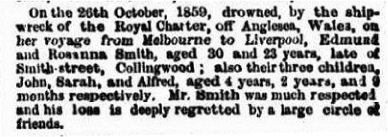
Russell and two children (Mr Russell saved), Mr. and Mrs. Smith and
three children. Soloman Samuel, Mr Lausan or Sanson, Julius Stirko,
or Stirks (Landed at Cork), Miss Elizabeth Ward, Miss Mary Ellen
Wrigley, Edward Watson, John Wilks, Mr. Watson, John Bradbury
(saved), Mr. Lyons and Family (wife and three children) two sons aged
10 and 12, J. Truatemen and family (two children), Henry Burns and
child (landed at Cork), Nathaniel Nathan, Alice Newton, Joseph
Churton, John and Catherine Drygan or Yaggan (landed at Cork), John
Judge(saved), Maurice Boyle, James Dean (saved), Wright Lockwood,
Joseph Moss, Mr. Faulkner and child, Robert Jeffery, P. De La Landa,
David Thompson, Mrs. Kennedy and family (two children), Thomas
Willis, J. Wickett and party, C. Jakeman, Messrs. Jones and Rice, C
Kisterman, Messrs Culina, Sturt, and Lyon; Charles Conway, MR.
Kirkbride and two sons, Mr. Kennedy and family (wife and three
children), William Banks, David Thomas, C.R. Ross, W.S.Fenis (saved),
J. McCappin (saved), T. Taylor, Robert Hagarth or Hogarth, Henry
Eughans, William and John Row, Messrs. Tripit and Lowe, William
Makepeace, Thomas Fawett, William Boden (saved), James King, Denis
Collins, William and T. Murry, John Buchanan, Coll. McPhall (Saved),
Joseph Robinson, Alex. Pottinger, R. Oliver and party, P. Hogarth and
family (one Child), William Ford, C. Shanahan, David Bell, William
Wilson, George Smith Michael Frawley, Messrs. Derose and Kenny, John
Fainby, R Laystaff, Frank Webber, George Watson, Mr. Holland and
family (three children), Issac Stephenson, Mrs. Athey and Child, T.
Newton, Agett Richards, James Stanard (saved), Edminster and Ellis,
Mr Terril, Jessie Thomden, Baptiste Phillipine, Bates and Rosely,
James Johnston, James Pardy, Joseph Spyaglio, George Chesney, Thomas
Byrne, John Grice, Matthew Scott, Houghton and Thomson, T. Wood,
Thomson and Milliken, Noah Lyons, Willam Green, Robert Tuck, Joseph
Gibson, John Wotherspoon, John Lynch, Charles Anderson, P. Thomson,
E. Fowler, H. Ivey, L. Porut, Michael Kavanagh, Antonio Albergath,
Dellin and Rolla, Morelli and Cavagna, John and P Martin, George
Leitu, Henry Lawton, George Taylor, Samuel Grenfell (saved), E Allen,
John Anderson, S Dalton, William Storey, W. Crowley, Mrs. Ross and
family (two Children, one an infant), D. Travers, T. Wyatt, James
Sullivan, James Turner, Mr. Cartney and family (three children), B.
Bladier, Mr. Paderitte, William Bishop, Mrs. Willis and family (two
Children), John Gillespie, Thomas Kelly, Mr. Mitchell and wife,
Willam Fleming, John Scott, John Muhlmann, Charles Parkington, John
Parkinton ( or Ranston), James Pamplin, Miss. Davidson, Henry Sims,
John Manion, Samuel Mosely Wade, NicolaPage, Mr McLeon and family
(two children), William Tany, John Ingis, Richard Davis, Joseph
Potts, Frank Hoyland, E. Willray, Miss. Susannah Morton, John Mason,
T. Bakewell, James Black, Beratti Vingenga.
THOSE OF THE CREW WHO WERE
SAVED.--- William Foster (carpenter), George Swaicar (boatswain's
mate), Edward Williams (boatswain's mate), Thomas Cormick (steward),
John Stanlard (steward), Thomas Ellis (storekeeper), Owen Williams
(quartermaster), Walter Hughes (apprentice), David Strongman (second
quartermaster), Tom Tims (seaman), Patrick Devine (rigger), James
White (rigger), John H. Richards (rigger), Thomas Cunningham
(rigger), William Barton (rigger), W. Dreaper (seaman), John O'Brien
(seaman), Joseph Rogers (seaman), Henry Evans (seaman), Thomas
Griffiths (seaman), William M'Carther (seaman), Edward Wilson
(seaman), G. Girvin (seaman), --- 23.
The scene of the wreck is
Moelfra, about nine miles from Beaumaris, and three or four miles
from where the Rothsay Castle was lost many years ago. Red Wharf Bay
is situated about three miles to the westward of Puffin Island, Menai
Straits, and six or seven miles to the Northwest of Beaumaris. With
the exception of the bay, which is very sandy and shallow, the coast
is rocky and bold.
Just on the eve of the
dreadful disaster the passengers, believing their voyage at an end,
had presented Captain Taylor with a piece of plate in testimony of
their appreciation of his ability and kindness. On the day of the
wreck the captain's wife and two daughters were awaiting him on the
North Landing Stage at Liverpool.
It will be readily
imagined that the wreck of the Royal Charter was a topic impressively
dwelt upon from many a pulpit on the following Sunday. Not the least
impressive discourse which referred to it was that of the Rev. Mr
Binney, who, had his wife not desired to make the journey overland,
might possibly have sailed for England in the ill-fated ship. A
Statement was lately published to the effect that Mr. Binney had at
one time, positively determined to take passage in the Royal Charter,
and had been prevented by the merest accident from doing so. At a
meeting, however, of his friends and congregation, held some evenings
ago at the London Tavern for the purpose of giving him a "welcome
home," Mr. Binney said :---"The fact was, that he had a
desire to return by the Cape Horn; but Mrs. Binney had decided three
months previous to their return, to come overland. If, however, they
had not decided to come overland , they would most probably have come
by the Royal Charter, as she lay in Melbourne at the time".
|